Showing posts with label conference report. Show all posts

Thursday, November 28, 2019

Conference Report from Lydia Gittens


Our final post on ROSACon2019 is from one of this year's scholarship recipients, Lydia Gittens. Thank you Lydia for sharing your experience with us!

* * *

A mere two and a half weeks have passed since the Rosa conference and I am still on cloud nine. Ask my poor colleagues they will confirm this.

My personal highlight? Everything. Okay I know that’s a bit of a cop-out. So let’s start at the beginning. The venue was beautiful. I felt like a Cinderella stepping into the prince’s castle. The food and snacks were fantastic.

The goody bag ROSA gave us was like having Christmas in September. The books are great and the treats ... need I say more.

But in all honesty it was the people that made this conference the success that it was. I want to start with my fellow conference goers. You guys are great. As a newbie I learned so much just from our informal chats around tea-times and mealtimes. Being able to network and just getting the nitty gritty (the do’s and don’ts) from those that have walked the hard and often lonely road to publishing a novel. Thank you for your willingness to share your journey with me and for the encouragement and warnings you gave me.

Moving on to the presentations: I can’t single out any presenters they were all very professional, interesting and loads of fun. I learned about things I knew nothing about. Such as: The challenging world of self-publishing. What it means to have an agent and how to obtain one. How to use social media effectively? To name just a few. The presentations literally covered most of the topics I as a newbie wanted to learn about.

I want to give a BIG shout out and a big THANK YOU to everyone at ROSA for gifting me with the scholarship. Making it possible for me to attend a conference that I know has and will impact my writing career from now and into the future.

Lydia Gittens
7 October 2019
(PS Watch out for my name thanks to ROSA CON 2019 you just might see it in the print)


Thursday, November 7, 2019

Conference report from Alissa Baxter


Today's post is from long-time ROSA member and ROSACon veteran Alissa Baxter.

* * * 

I attended this year’s ROSA conference this year, and I found the range of topics that were presented very interesting. I particularly enjoyed listening to Whitney Ross give us an insider’s view into traditional publishing in the United States.

Whitney represents middle grade, young adult, and adult fiction across all genres, including historical, science fiction and fantasy, romance, and contemporary fiction.

She joined the Irene Goodman agency in 2018, and before that she worked as an editor at Macmillan for nearly ten years, so she is uniquely qualified to give authors an insight into the mysterious world of traditional publishing.

I was very interested to learn about how many imprints the big publishers have. It can be overwhelming to know where to start looking for a publisher, especially when there are so many imprints in each house. Literary agents act as the gatekeepers of the traditional publishing houses, and therefore, if you wish to go the traditional publishing route, it is important to know how to set about finding an agent who is the right fit for you.

Whitney gave us some great tips on how to write a good query letter, and she explained the role of an agent in terms of the business side of publishing. She also warned us about agents who might not be what they seem (“schmagents”), and she showed us examples of query letters which grabbed her attention, and those that didn’t.

It was a fascinating talk, and it demystified the role of literary agents and exactly what it is that they do for authors. Some agents have more of an editorial focus (Whitney is an editorial agent), but all agents bring a unique set of skills to the table, and it’s important to find one that is a good fit for you – that’s if you decide to go the traditional publishing route. If you would prefer to go it alone, self-publishing allows you to manage the entire publishing process yourself, but that’s the topic of another blog post entirely – and I’m sure someone will be writing a post about Ashleigh Giannoccaro’s fascinating talk about this topic.

Whitney Ross - image courtesy of Suzanne Jefferies


Monday, October 28, 2019

Review of ROSACon2019


Today's guest post is by Cynthia Kistasamy, a conference first timer.

* * *

I pitched up at ROSAcon 2019, on the first morning, not knowing what to expect. I was a bundle of nerves, wondering whether I was in the right place for a writer starting out. By the end of the last day, during the last session, I realized that I didn’t want ROSAcon 2019 to end. Sadness filled me as the event drew to a close. It was by far one of the most thrilling, fascinating, awe-inspiring workshops/conferences I’ve had the pleasure of attending.

ROSAcon 2019, was in a sentence, absolute fun while learning.

I left swimming in information (perhaps drowning would be a more accurate description as there was so much of valuable info shared over those two days) that more seasoned writers openly gave without reserve.

There was a genuine sense of camaraderie and encouragement.

Each session was conducted by book professionals and authors filled with passion for romance writing and wanting to help others, from beginners, like myself, to those further down the line in their writing careers.

Highlights of the event for me were the panel discussions, in particular ‘The Biggest Mistakes We’ve Made’, in which established authors spoke honestly about their writing journeys to the point of success. It was nice to hear their own personal accounts and know that even accomplished authors start with nothing but a manuscript and hope, and that blunders along the way are common, and that you just need to be brave and push along fearlessly.

Dani René, Ashleigh Giannoccaro, Romy Sommer, Suzanne Jefferies, Whitney Ross, Sharonlee Holder, to name a few, all shared their best secrets to a thriving writing career. In fact, everybody I spoke to at the event had something of value to impart.

I could not believe that I had landed smack bang in the middle of romance writing heaven, surrounded by enthusiasts like myself.

Next year I will be first in line to book my ticket. ROSAcon 2020…can’t wait!


Friday, November 23, 2018

5 Reasons to love ROSACon


Today's guest post is from Anthony Ehlers, who has not only attended every ROSA conference to date, but has been a guest speaker at almost all of them too.

* * *

This year, we celebrated five years of our ROSA Conference and, as usual, it was a success. To mark this milestone event, here are five reaons you’ll love ROSACon if you’re a romance writer.

① You’ll network. Every writer at the conference is at a different stage of their journey – some are multi-published, others just starting out. Everyone has different skills, contacts and insights. It’s a great place to meet people who will support you – and where you can support others.

② You’ll stay ahead of trends. The conference is a great place to know what trends are coming up in English and Afrikaans publishing – discover what agents and editors are looking for and what self published and independent authors are doing to write, market and sell their books.

③ You’ll learn. From learning more about the craft of writing to the business side of being a writer, from the pyshcology of staying positive and motivated to the insights you gain from how other writers work and live, ROSACon has it all.

④ You’ll experience fellowship. It’s always good to go back and be part of one’s “tribe” – and ROSA is about meeting up with people who don’t share your interest but your passion for love stories.

⑤ You’ll be (very) inspired. Writing isn’t easy – it’s often lonely and hard work. But we do it because we absolutley love telling stories. It’s always inspiring to see other writers living their dreams – some of it is sweat, no doubt, but most of it is pure glow!

Don’t miss next year’s ROSA Conference – you’ll fall in love with the love of romance writing (for the first time, or all over again!)

Tuesday, November 6, 2018

Peter Barker on #ROSACon2018


Today's post is a guest post from author Peter Barker on his experience at the ROSACon 2018 conference held in Johannesburg in September.

* * *

When I signed up for the 2018 ROSA conference I was a bit apprehensive that I would be hearing a lot of the same stuff again. This was the third conference that I have attended and the second one where I have attended the entire conference. My apprehensions were set aside. I discovered that there is always more to learn.

What did I learn? Where there were concurrent sessions I of course did not attend the alternate presentations. I left the conference a great deal wiser on:-

  • Portraying Emotional conflict in writing
  • The wonders of an internet product called Wattpad
  • The market for Christian and other inspirational literature
  • The legal and business side of writing
  • Goal setting
  • The latest and greatest in writing trends
  • The status of marketing books in SA and abroad
  • How to write a synopsis
  • The secrets of market related copy writing
  • Overcoming self defeating behaviours
  • What to do with difficult heroes
  • Advertising on the Internet


Those of you who couldn’t make it this year, see what you missed! Don’t make the same mistake next year. Be there!!

What I also appreciate about attending the conferences is the opportunity to talk about writing with like minded people. When I get excited about an aspect of writing around the dinner table at home I notice eyes rolling and yawns being stifled. It was wonderful to sit down at meal times at the conference and at the banquet and have a really good in depth discussion about our beloved craft.

Tuesday, October 16, 2018

Jayne Bauling on #ROSACon2018


Today's post is a guest post from author Jayne Bauling on her experience at our recent ROSACon 2018 conference for romance writers in Johannesburg.

* * *

Closing the laptop and hanging out with other writers for a couple of days at festivals, fairs or conferences is always a pleasure. Of the seven book and/or writing events I’ve attended this year, ROSACon 2018 is in the top three for excellent organisation, so congratulations to Romy and her team. I love it when things run smoothly.

The other six were ‘work’, so the ROSA conference was a treat I decided to give myself, where I had nothing to do except listen to other people being informative and entertaining. I came home feeling updated and in touch – and so refreshed.

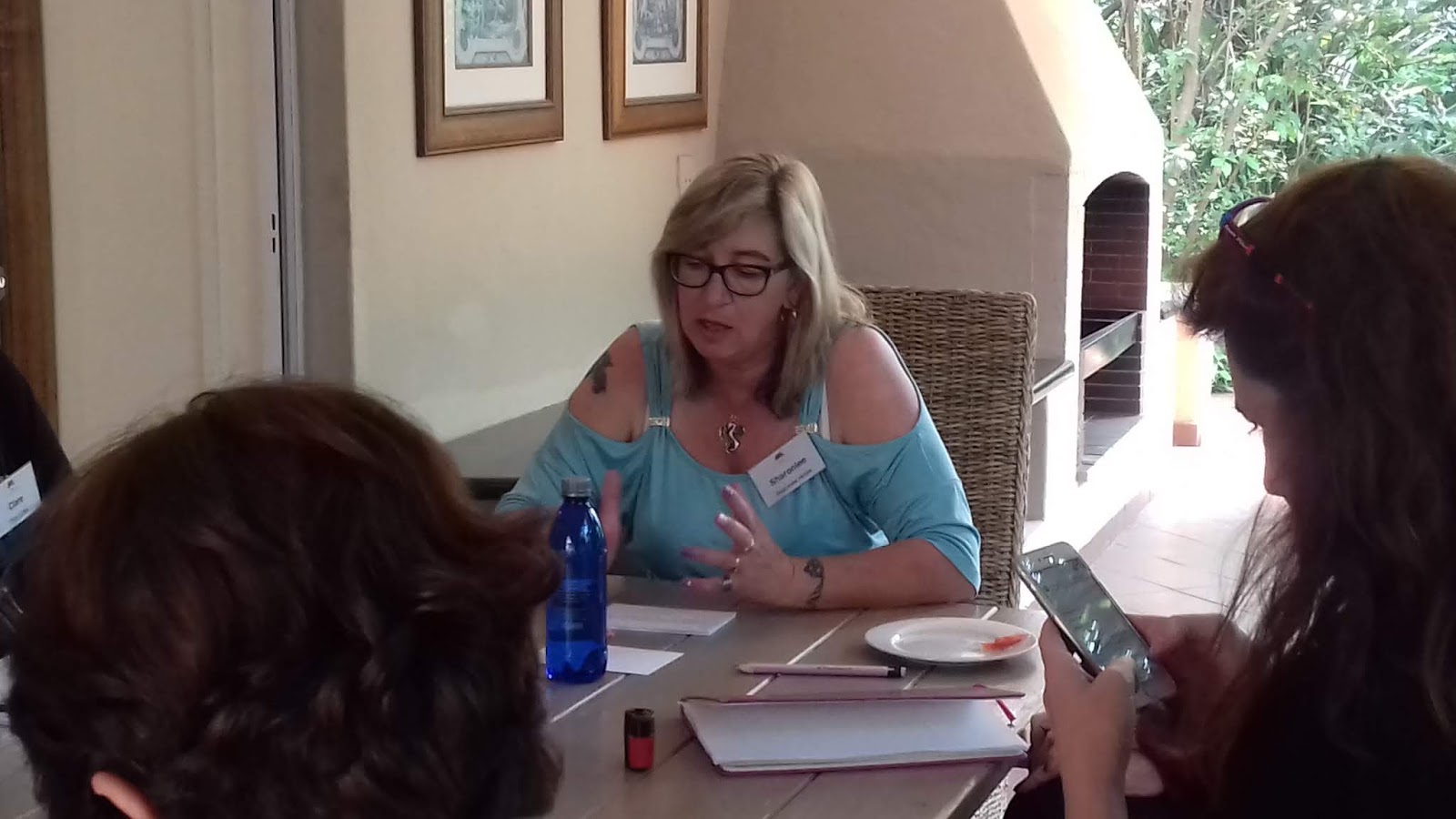
Melrose Place was the ideal venue, a comfortable and relaxing setting. The programme was well-balanced, with a stimulating variety of speakers and topics. There really was something for everyone, and sometimes something new: for example, I read very little paranormal fiction, romantic or otherwise, and will never attempt to write it (wait, never say never), but Sharonlee Holder’s session on Writing Paranormal was so much fun.

Sharonlee Holder's session on Writing Paranormal

There wasn’t a single session I didn’t enjoy and benefit from, out of those I attended. Thank you, everyone!

Something that struck me repeatedly was how supportive of each other all the ROSA writers were, published and yet-to-be alike. That’s something I appreciate about the South African writing community generally, but it was especially evident at the ROSA conference.

Thank you again, everyone, and congratulations to the Imbali and Strelitzia winners and finalists. Oh, and the goodie bags were amazingly generous!

Some of the goodie bag goodies

Tuesday, January 30, 2018

A word or two about ROSA’s 2017 guest speaker, Jane Porter

Thank you to ROSA committee member and Strelitzia 2018 mentor Suzanne Jefferies for today's post on her experience at #ROSACon2017, and what she learned from our keynote speaker, Jane Porter.

***

I’ll fess up – I had no idea who Jane Porter was. I’d never read her romances, watched any movies based on her romances, or dipped into the advice she serves up in her ‘how to’s. I had heard of Tule, but was damned if I knew how to pronounce it (rhymes with Julie, who knew?). Yes, she’s an international bestselling author, and a publisher - that you can get from a quick Google trawl. But, stats tell you nothing about the person, Jane Porter. What I didn’t expect was to find someone who stripped me straight to my emotional bones in her frankness, her willingness to share her story, and her reassuring quiet strength; aye, she may be small but she is mighty.

Laying your guts out to the public is probably why writers are such ‘crazy cats’ (to use Jane’s expression). But it’s not often that a writer stands up and says it – no hiding under the covers - to a room full of strangers. Raw, unadulterated, 100% honesty. Is it easy to hear? No. But, for this writer here, it was a turning point. If I can’t be honest about who I am, where I’m from, and the experiences that have shaped me, my stories are probably going to lack authenticity. They won’t reflect ‘me’. For that alone, I’d pay over the odds a million times, to hear Jane speak again.

In both her talks, and in conversation with her, she offered priceless insights into romance writing as a career. A career option, that, let’s face it, is not offered by guidance counsellors. And why shouldn’t we be thinking of writing as a career? How many other careers let you research hot men on the Internet? Not accounting, that’s for sure.

These were some of the biggies:
  1. Grit. Hanging tough. Getting knocked down and getting back up again. These are the things that make a writer. Not talent. Or fancy degrees. Honest to goodness perseverance. How many books till Jane got a ‘yes’? Fifteen? How many of us would give up after one? Two? The publishing world is dark and full of terrors; houses closing down, editors disappearing mid-revisions, unrenewed contracts, books that don’t sell. Pick yourself up, dust yourself off and head out there again – that’s how writing careers are forged. Blood, sweat and tears.
  2. Why write a standalone, if you can write a series? Think in threes, in fives, in sevens. Find a theme, a family, a geography, a ‘something’ that can link your stories together. Publishers love this. Heck, as a reader, I love this. I’m still excited at the prospect of another Black Dagger Brotherhood novel – and she’s on what?, book twelve or something? Ditto Gena Showalter.
  3. A publisher would prefer to get more buck for their bang…so maybe stretch those words counts to the forties and fifties. They (the publisher) can charge more. Happiness and beams all round. It also means you might get a few more dollars too. So, if you can write to 25,000 words, extend extend extend.
  4. Pick a genre. Contemporary, paranormal, historical, whatever floats your boat. Don’t start up in contemporary, then drift over to historical, and then maybe a scifi. Romance readers don’t drift – you shouldn’t either. Maybe two at the maximum. 
Every now and then, I’ll remember something else she said, and I’ll write it down; things like how to engage on Facebook and start conversations with fans, or how to recognise alpha men. And then I’ll think how lucky I was that of all the places Jane exchanged to as teen, it was here, South Africa. Sometimes these things aren’t accidents. Thank you, Jane.

Wednesday, November 15, 2017

Top three things I learnt at ROSACon 2017 by Suzanne Jefferies


Do you think you might have missed something important from ROSACon 2017? You know, because it’s two whole days of talks and workshops with romance writers, editors, agents and publishers? Because it’s all about romance writing? Don’t worry, I’ve got you covered.


The top three things I learnt at ROSACon2017


1. An imposter lies in all of us (see what I did there?)

Rae Rivers spoke about imposter syndrome
and was the Imbali Award winner
He/she/it lies about your ability, your talent, your ideas, just about everything. It will tell you that you can’t write, shouldn’t write, have no right to write. Your imposter is a lousy, stinking, lying toad, catching your insecurities like flies and belching them back to you. Chain him up, banish him back to the river, or regard his remarks with the disdain they deserve. Even Neil Armstrong feels like an imposter. Neil Armstrong. His toad’s a total dick.

2. Writing is a journey more fraught with pitfalls than an episode of Stranger Things.

Just when you think you’ve got it worked out and you’re on track, something will turn everything upside-down. Contracts get axed, publishers disappear, agents mushroom up with promises of fairy lights and otherworldly reach, and you’re left trying to figure out if this isn’t perhaps some sort of conspiracy. Do we stop writing? No. Do we stop trying? No. Do you put on your boots and confront the demagorgon, sorry, challenges? Hell to the yes. Think of it as a curiosity voyage, and writing as the paddles (with apologies to the Duffers).

3. Heeltyd heeltyd speeltyd.

Looking to write for the US market? They’re looking for hard bodies and hot story lines. But writing sexy scenes requires a few glasses of wine, and a euphemism-free vocabulary. Here are some words you might want to consider editing out of your dicktionary: love muscle, throbbing member, cruise missile, hot meat injection, love sword, eight inches of blunt fury or deep-veined purple-helmeted Spartan of love. Just a suggestion…don’t take my word for it.


Did I say top three? There were about twenty four thousand five hundred and a million other things I learnt. Roll on, ROSACon 2018.
- Suzanne Jefferies is a ROSA committee member and fellow author, read about her here.

If you did miss out on RosaCon 2017, don't forget that the Western Cape Writers' Retreat will be taking place 3 - 4 March 2018. Email: romy@romancewriters.co.za

Wednesday, March 22, 2017

Western Cape Writer’s Retreat 2017 by Tracey Wilson


Wondering what else you missed at the retreat? Tracy Wilson writes about her experience at the ROSA Writers' Retreat 2017 that took place in Cape Town in February. 

Lalapanzi Lodge: image credit Lalapanzi Lodge


Nestled in a tranquil forest of fir trees overlooking False Bay, Lalapanzi Lodge provided an idyllic location for the Western Cape Writer’s Retreat.  The rugged peaks of the Hottentots Holland Mountains accentuated the azure skies of the Cape behind the timber lodge, while a gentle sea breeze offered relief from the heatwave that had besieged the Mother City that week. 

Yes, the setting inspired my imagination, and was a great choice for a gathering of romance writers. 
Sixteen ladies attended, including the speakers.  The size provided an opportunity for newbies, such as myself, to meet other writers.  The ladies were all friendly and lively and lovely.  Not surprising when one considers that romance writers focus so much of their novels on the issues of the heart.  And I believe romance writers have the biggest hearts of all writers.

Romy Sommer, author and chairperson of ROSA, presented the first session on Mastering Story Structure.  Michael Hauge’s Six Stage Plot Structure is a formulaic approach to structuring a novel.  The first “How to…”  writing guide I purchased taught me the value of applying the three-act structure model to my writing.  Hauge’s model strengthens this by teaching that there are six basic stages within the three-act structure, which are defined by five key turning points in the plot.  These turning points usually happen at the same point (or percentage) of the running time of a movie, the pages of a screenplay or novel.  I can almost hear the plotters cheering and pantsers sneering, but I believe Hauge’s template can assist any writing method.  It helps plotters outline their first draft, while pantsers can use the template when editing their first draft, thereby ensuring that each writer’s creative paradigm remains intact.  Romy demonstrated this technique by referring to examples from popular movies to highlight the inner and outer journey of the main character.  I’ve visited Hauge’s website, www.StoryMastery.com to learn more about his Six Stage Plot Structure and am looking forward to applying his method to my writing.

Louise Fury, former Capetonian and literary agent extraordinaire for the Bent Agency in New York, taught us the importance of Query Writing.  I liked how she compared the query letter to a business letter that a professional person (the author) with a business proposal (the novel) sends to a professional organisation (the agent).  The author-agent relationship is an equal partnership between the author, who brings the “asset”, and the agent who brings the contacts and expertise.  I learnt that a query letter is the point of first contact and should be brief, clear, and professional.  The ideal word count is 250 words, but no more than 300 words.  It’s an introduction, not a synopsis which describes your plot.  A pitch should tell the agent who the main characters are, what they want (motivation), and what’s standing in their way (conflict).  A short bio should conclude the letter, and your social media links included after your signature (thereby, not counting toward your word count).

After lunch, Louise Fury taught us the importance of Marketing and Social Media.  These days, more and more publishers are relying on authors to market their books on their social media networks.  In fact, publishers take your social media reach into consideration when negotiating the advance payment of your contract.  With so many platforms to choose from, it can become quite daunting.  The pros and cons of various social networks were discussed by the techies in our group, as well as ways to improve your site’s ranking (SEO).  Louise’s advice to us was to focus on Facebook, Twitter, and building a personal website - with Facebook, usually, generating the most sales for authors.

In case you missed it on Facebook, here's Louise Fury encouraging ROSA members to attend Rosa events and Meet-ups.


Rae Rivers, author of The Keepers paranormal romance series, presented the final topic of the day, Impostor Syndrome from the book The Secret Thoughts of Successful Woman by Dr Valerie Young.  Impostor syndrome describes high-achieving adults who are unable to internalise their accomplishments and constantly fear being exposed as a fraud.  They‘re unable to enjoy the success they’ve achieved, often dismissing it as luck.  It affects 70% of the world’s population, mainly women.  Rae discussed the four levels of competency - I’m a perfectionist.  And the coping mechanisms we employ to deal with failure – I tend to procrastinate, which often stalls my writing.  It’s vital to recognise how you feel, find someone you trust to talk to, don’t be afraid to ask questions from other writers, practice, practice, practice, and give yourself permission to fail.  I liked the way Rae phrased it, “Acknowledge it.  Accept it.  And move forward.”  Thank you, Rae, for sharing your own journey with us.

Thank you Romy, Louise and Rae for you presentations.  I gained a lot of knowledge at the writer’s retreat and made many new friends.


Tracy Wilson


If you live in Cape Town and want to hook up with a couple of locally based ROSA members, our next meet up is 8 April at 13:00 in Durbanville. More details HERE.


Tuesday, March 14, 2017

Cape Town Retreat Feedback from Dawn Rae


Dawn Rae (Left) with Louise Fury and Sumi Singh 

I'm not a member but I signed up for the ROSA Writers' Retreat specifically to hear Louise Fury speak about query letters. I got that and so much more. Louise shared knowledge and experience from her life as an agent, and she was always ready to hear what we were working on. Many of us benefited from her excellent advice so freely given.

I learnt that published authors also struggle, and although writing is a solitary calling, I am not alone. Rae Rivers spoke about Imposter Syndrome, something that even established writers do battle with, and I realised as I listened that I was feeling it right then. 

I learnt the importance of social media in a writer's success, and I now understand why I need a website. Since the retreat I've got myself onto Twitter - no idea what I'm doing yet but at least I've got the account!

I learnt that being part of a like-minded community brings benefits of support and friendship, and I felt welcomed into this group of awesome ladies. I'm so looking forward to our first informal get-together, happening soon.

For me, the way forward is to join ROSA and make sure I never miss out again on wonderful events like this one.

Wednesday, November 23, 2016

Elaine Pillay shares...'What I gained from the ROSA Conference'


It was with a heavy heart that I attended the ROSA Conference this year. Not for any other reason but that I felt as though my own book that was published was not seeing the light of day or not being read by the audience it was intended for.

Nevertheless, Romy Sommer had asked me to speak at the conference and so I attended. Boy, was I glad that I did, at the end of it.

I learnt so much from the writers who presented that day. I was in awe of the women who presented. They were so in charge of their dream and their craft. So in sync with what they were doing. At that point I almost wished one could bottle and buy that kind of energy at the conference.

Image credit: Joanne Macgregor.com
Joanne Macgregor (Author of so many books, her latest being “Rebel”) was up first and she had a lot to say. Joanne is eloquent and very matter of fact about her experiences and her job. I am an introvert by nature and as such the thought of marketing my book has always been a daunting task which would explain why my target market had never seen it. I wanted to write a book that would sell itself. That, I learnt, does not happen. Joanne talked about how, if you wanted to sell your book, then you need not take yourself so seriously. “Get over yourself,” she said, “if you want to sell your book.”
She mentioned how if one was ever serious about being a writer, then one had to have a website. That too was something that I didn’t want to do. Not sure why but possibly the introverted thing rearing its ugly head again.

I love writing and I have always believed that all one did was write in a tiny room with a beautiful view. That’s the picture I’ve always had in my head. Me writing in a small room with the view of a lake and there’s a steaming mug of coffee next to me. Quiet moments. Silent reveries. Not the website and the hustling at conferences and standing with the mic. Those things terrify me.

But now here was Joanne with her business like attitude about books and writing telling me everything I didn’t want to hear about writing. Speak. Turn up at writer events. Hustle, hustle, hustle. At the end of the talk I watched her pack up, toss her hair and walk out of the venue to have a cup of coffee.

Lord, let me be like her, I said silently.

Next up was Rae Rivers, Harper Impulse Author of “The Keepers” series. Rae is quieter but by no means less of a powerhouse. Rae woke me up in a different way. Due to my not knowing how the sales of my book were going, I refused to write. Not refused out loud but in my manner toward writing. I hadn’t written in over a year. I had many excuses why not, ‘tired’ featured most prominently, together with, ‘I need to re-decorate the study’. I avoided the study at all costs and just went in to usher the dogs out whenever they managed to wander in.


Rae spoke of the fear of writing. At first I thought good gracious me, whoever would suffer from that? But as she spoke in her quiet, convincing way, I thought of how that was applicable to me. I was afraid to write because in my mind, writing a book and getting it published wasn’t everything I had dreamed it to be. In fact, up until then, it had turned out to be the biggest waste of time. An indulgence. But Rae made a lot of sense. She related her experiences to the topic and suddenly it all made sense.

There are very few people in the world insane enough to have the illusive dream of being a writer, there are an even smaller number of us who dare to believe that we can make a living of it. And because we are so far and few very rarely do we meet to discuss the psyche of writing and therefore many times we suffer the “evils” of writing in solitary confinement.

Attending the conference was fruitful for me because two things happened: Unbeknownst to both of them, Rae diagnosed my writing illness and Joanne kicked me into action.

I took what Joanne said to heart, not because of what she said but because of how she said it. Joanne has an incredible vibe. When she speaks, she is books. She is her business and somehow, she made me believe that I was my business too.

After returning from the conference, I started up my website. As difficult as it was to do, I realised that if I hid, then my book was hidden too. I had to come out in public and show who I was and what I do. I also realised that I was the only person who could sell my book. I knew what I wrote and why I wrote it. Joanne Macgregor made me see that if I wanted to be taken seriously, then I had to be serious about what I did.

Thanks to Rae Rivers, I also started writing again. Not in front of a lake or in a newly decorated study.  Rae’s talk unblocked the sludge of excuses. Rae quietly smacked that sludge off me. My self-worth as a writer wasn’t based on the royalties I received or the accolades I got for the book. It was based on what I believed my purpose was. On what I decided my life would be about. It is and always has been that writing is who I am. It is what I was born to do.

So, should you attend the conference next year?
My question is, how can you afford not to be in a room with dynamic people who understand the insanity of your dream?

Elaine Pillay


Wednesday, November 16, 2016

Carlyle Labuschagne on Branding for the Brave

Image credit: Marie Dry
At ROSACon2016, successful local YA author Carlyle Labuschagne presented a talk on Branding for the Brave.

She opened the session with an exercise, getting us all to think about our own brands: what is the end result we desire from our branding? What are our core values? Who are our role models, and why?
Only once we have a grip on who we are, and what we stand for, can we establish our author brand.

Carlyle shared some excellent advice for author branding:

  • offer value to your readers
  • Put out a clear, simple message
  • Be consistent across all media and platforms

She also shared concrete, specific tips on how to run giveaways and contests, use graphics and teasers, and how to use social media features such as Teaser Tuesday. She recommended collaborations between authors and bloggers as a great way to spread awareness of our brands.

But perhaps the most valuable piece of advice she shared was that authors must show passion for their own brands. If you are not enthusiastic and excited about your own work, and your own brand, how can you expect anyone else to be?

Thursday, November 10, 2016

#ROSACon2016: Inspiration to be an authorpreneur


Romance Writers of South Africa

Walking into a room of women with impressive writing CVs can be both intimidating and inspirational. This was my experience when I attended the second day of the ROSA Conference 2016.
From my very first moment I was astounded with the amazing sisterhood, but business-minded attitude that existed between these writers. 
Though I was there because I’m an aspiring writer, it felt like hanging out with your tribe – while still learning by being in the company of Romy Sommer, Joss Wood, Joanne MacGregor, Rae Rivers and Rebecca Crowley.
Joss Wood’s workshop gave me ideas and inspiration for all the books I haven’t written. (I mean, just being in her presence makes you create heroines for you books: Both sassy, fun, strong and kind – Joss is the heroine we aspire to write and be). Romy’s showed me where to looked for research for your book and how small details make your story seem more believable. It was also during Romy’s session that I realized how research and using all research tools makes your characters more real to yourself and how it can translate to the page.
Joanne MacGregor intimidated the living daylights out of me, but boeta, the woman inspired me to become an authorpreneur.
To be a writer is viewed as a creative process. You are an artist who creates a world out of twenty six letters. But the writers at the ROSACon 2016 showed me they are also business women.
In the words of Joanne MacGregor: “If you want to be a traditional torture writer selling no copies, then write in that dark corner. But if you want to be selling author, you have to hustle!”
And hustle I shall!
This rang true to me because writers of romance have to juggle a lot of different roles, while receiving a huge amount of disrespect from the literary community. Yes, these writers create a great product, but they are also the marketers, their own CEO’s and their own financial managers. All the while working other jobs - and the proof is in the sales, because romance sells!   
Rae Rivers’s talk about fear, was especially touching and it’s a workshop every writer should attend, because the fear of failure is universal. To control your fear is a great accomplishment and Rae gave easy, useful guidelines on how to turn your fear-enemy into a trusted ally.  
I walked out of ROSACon 2016 wishing it was a week long and feeling inspired, but more than that my whole perception of writing changed.

Cliffordene was also the winner of the Three's Company writing conference contest this year.


Wednesday, November 2, 2016

Rae Rivers talks about Facing the Fear


Image credit: wikipedia

Rae Rivers signed a contract with Harper Collins, a 4 book deal to be carried out over a 3 year period – a formidable task for any writer.  She suffered severe anxiety and fear of failing, of letting herself down and failing her editor and her readers.  The intense anxiety led her to suffer from the dread disease of writer’s block which served to intensify an already negative situation.

She asked the question:  “How do we combat fear?”  And promptly answered it by stating that we should never INVALIDATE or DISMISS our fears.  Rather EMBRACE them and NAME them.  Rather than fall into self pity and despise herself, she started to define her fears.  In this way she came to create a character called Gru, an old grey man with a sad and lugubrious expression on his face, wearing an old- fashioned grey large-checked suit.  He was the embodiment of her fears – a kind of comic character she showed in her video presentation, shaped like an inverted triangle with broad shoulders narrowing down to the tip of ‘V’ of his small shoes.     


Image credit: raerivers.com

Gru represented her fears but also helped and advised her how to come to terms with them.  She could discuss her problems with him without pretence since he knew her weaknesses.  He became a kind a sounding board for all fears and anxieties in her life, not only those relating to her writing and she could discuss these with him as he accompanied her in the car where she knew they were safe with safety belts and air bags (as she pointed out to Gru).

As a ‘hands on’ student of Jung psychology, I could identify with the character of Gru who was really a creation of “Active Imagination”, namely a spontaneous image of Rae’s fears which she created to help her in a dialogue of discussion and resolution.  Significantly he was male, an embodiment of Jung’s concept of the animus as the masculine element in feminine psychology, just as the anima is the feminine aspect of the male psyche and leads him to creativity.

Rae Rivers

 ACCEPT, IDENTIFY and ACKNOWLEDGE!   Those were the keynote words of Rae’s address with regard to “Facing the Fear”.
Feel free to take a look at Susan Dennard’s website www.susandennard.com


Words by Dr Pamela Heller-Stern who attended ROSACon16


Tuesday, October 18, 2016

#WriterTip Crafting and Creating Conflict in your Romance Novel


Romance Writers Organisation of SA


Erica Taylor, one of our ROSA members who attended #ROSACon16 and a session by Joss Wood on Conflict, has kindly shared her thoughts on the talk and what she learned.

What struck me most about Joss’ lecture on conflict was how much it made sense. It is probably something that we all do subconsciously without even realizing it, or having a literary definition attached to it, but having it defined made me more aware that it was another tool I had in my storytelling arsenal.  Joss tells us the way to tell a good story is make your characters go through crap—people don’t want smooth sailing and enduring love from the get-go. Readers want to be tortured with the characters, to hang on to the belief that love will conquer all, and to ride the happily-ever-after high into the tediousness of real life.

Using excerpts from one of her own novels, The Honeymoon Arrangement, Joss toured the lecture through the process of setting up conflict and using it as a tool to move the story along. 


Characters should have a “misguided external goal based on an internal goal,” or what the character thinks they want (point A) versus what that actually need (point B. Throughout the story, your characters will work through the conflicts you put in their path, getting them from point A to point B. 

Characters start off as silly little things thinking they know everything in their perfect little worlds and they have everything figured out. Ha! Little did they know the author of their story is about to shake up their world and they will be better for it, and their author will torture them until they come to realize, the author was right all along.

Joss explained there are two types of conflict: External conflict is the stuff happening around your characters. Internal conflict is the stuff happening inside the characters mind, their thoughts and worries and whatnot. And each character is different—whatever he/she wants must be specific to him or her.


“If your hero is a firefighter, your heroine better be an arsonist.” - Joss Wood

Three types of External Conflict:
  • Character vs. character (When opposite personalities attract—and clash)
  • Character vs. nature (When a hero faces an earthquake)
  • Character vs. Society (When a Lord falls in love with a maid)

Ways to up the conflict:
  • Use the characters fears again them.
  • Concoct the worst thing that could happen to them, then torture them with it.
  • Dig deep. Look back to their childhood—an author is part storyteller, part psychiatrist.
  • Find that thing that sends them off the deep end, and use it!

An example from Joss’ novel The Honeymoon Arrangement:
Internal: What are their deepest wounds and what scares them the most?
The heroine has deep rooted issues with her estranged mother.
External: Make that thing happen>>>>Mom calls her on the phone and sends the heroine spiraling into self-destruct mode.

What was most interesting about what Joss’ lecture, was how natural it seemed. Even in our everyday lives things pop-up that question our internal resolve. Challenges arise, things happen and the external conflicts we deal with each day have shaped who we are and dictate our internal conflicts. Readers read romance as a means of escape, searching for a trace of hope that no matter what happens in our lives, there is someone who will love us for who we are. As writers, we achieve the same escapism when we create this insurmountable problems for our characters and find a way to achieve their happily-ever-afters. 

We need to believe in the power of love just as much as the reader. We need to believe that no matter what life throws at us, everything will be okay. Writing conflict into your story not only moves the narrative along in a tangible, believable way, it adds a sense of realism to the story. Readers will relate to a flawed character, one who harbors secrets and refrains from letting their crazy hang out for the world to see, and when there is someone who can overlook their flaws, we want to hang on to that person even tighter. We root for someone to overcome the mundane conflicts in their life, because we all need to believe we can do it too.

Tuesday, October 11, 2016

The Tipping Point: Creating Sensual Tension in Scenes

Fellow ROSA member Anthony Ehlers shared some useful tips for creating sensual tension in scenes at ROSACon 2016. Here's what he had to say.

"In my workshop on writing scenes at ROSACon 2016, I spoke about the need to build sensual and emotional tension in each scene. This is probably the real reason readers come to romance novels – whether they’re erotic or sweet, modern or historical. That’s why it’s so important to keep the reader in mind when you’re writing a scene."

Top Tips for Creating Sensual Tension
  • ·        Don’t bog the scene down in plot – give just enough to keep the story going.
  • ·   Focus on the developing relationship between the characters – play on their fears, vulnerabilities, etc.
  • ·        Use as many of the senses as possible – touch, taste, smell, sound, sight.
  • ·       Sometimes you don’t need a lot of dialogue – wordless tension and a sense of mystery can work well.
  • ·      And most of all, slow down: don’t hurry the scene and you’ll keep the tension drawn out.

 A lesson from the pro's


image credit: abebooks.co.uk
Anthony says, "One my favourite Mills & Boon titles, the classic 70s Leopard in the Snow by Anne Mather, makes imaginative use of the timeless Beauty & the Beast theme. Helen, our heroine, is trapped by a snow storm at the country retreat of Dominic, a racing car driver the world believes has died in a crash. And because she knows his identity, he forbids her to leave!

In one of the most memorable scenes, Helen sneaks down into the basement of the house where a naked Dominic lies prone in a sauna room. He is expecting his manservant, Bolt, to administer his afternoon massage to his damaged body – instead Helen creeps in and starts to touch him. The tension here is off the charts. Will he discover it’s not Bolt? How will react to Helen seeing his vulnerable body? 
image credit: goodreads.com


In Jane Porter’s awesome Modern/Presents title, Christos’s Promise, Alysia has been secluded in a convent and is rescued by wealthy Greek magnate, Christos. Theirs will not be a marriage of convenience, he declares, and while he will never force her into intimacy, they will share a bed.

On their honeymoon yacht, Alysia lies awake while her new husband slips into bed beside her. As he falls asleep, he cradles her and becomes aroused. The tension between the natural state of sleep of Christos and the hyper-awareness of his bride make this one of the most breath-stealing scenes in romance fiction – even 15 years after reading it!"

What are some of the amazingly sensual tension scenes you’ve read or written?

image credit: bookslive.com
Anthony Ehlers is a writer, scriptwriter and creative writing teacher. In 2014, his scripts were shortlisted for the Jameson First Shot competition, as well as the European Independent Film Festival. In 2010, his story “Limerence” was a runner-up in the annual Woman & Home short story competition. He is one of only two authors to appear in the first two Short.Sharp.Stories collections. His story Breaking the Rules was published in the Adults Only collection in 2014.


Tuesday, November 10, 2015

Begging!

To everyone who attended #ROSACon2015 in Stellenbosch:

We have now run out of reports on the sessions of the conference to post on the blog. The reports we are still outstanding are:

  • Marie Dry's discussion on 'Just because you could, doesn't mean you should'
  • Every single session from the second day!

Please could you submit any reports you offered to write (unless it has already been published on the blog below) to Romy Sommer on admin@romancewriters.co.za as soon as possible, or alternately please volunteer to write something?


Friday, November 6, 2015

#ROSACon2015: Romy Sommer on Conflict

Thank you to author Linze Brandon for this report back on Romy's talk on External vs Internal Conflict.


Romy dealt with the one subject that differentiates a narrative from a story, the dull from the exciting - conflict.

Without conflict in a story, there is no motivation for the reader to finish the story. The reader will not be rooting for the hero (and heroine) and will soon be bored since there will be nothing that drives the story to its conclusion.

Does the hero overcome his biggest obstacle? Do the hero and heroine finally overcome their past prejudices, fears, histories, problems and let their hearts embrace the love waiting for them?

Even in romance fiction external conflict needs to assist in the internal conflict that drives the story forward. The main plot is the development of the relationship, and the focus must remain on the romance even in romantic sub-genres.

Romy addressed both the aspects of internal conflict and external conflict in category romance fiction with clear examples and focus on the genre's expectations.

Romance stories are primarily stories about relationships, and the motivation (or lack thereof) that the main characters experience to get to their happily ever after.

All other story structures need to support this concept and Romy addressed this with clarity in her talk. She also went on to explain what conflict is not, as these situations are often confused with what does constitute the conflict in the scene.

Overall a talk well worth listening to, even for published authors as we sometimes need a reminder of the essential elements of the stories that we write.

~Romy Sommer is the Chairperson and one of the founding members of ROSA.
~Linzé Brandon is a member of ROSA and the administrator of the official Twitter account @SARomance


Friday, October 30, 2015

#ROSACon2015: Carolyn Meads on 'Wat uitgewers in Liefdesverhale begeer'

Once again thanks to Elsa Winckler for this report back on #ROSACon2015. The guest speaker, Carolyn Meads is an editor at NB Uitgewers, responsible for their Afrikaans romance lines. She spoke about what publishers look for in romances.


Wat uitgewers begeer:

Carolyn Meads, Uitgewer: Queillerie (drukkersnaam van NB Uitgewers)

Carolyn het in haar hoedanigheid as uitgewer gesels oor wat uitgewers verlang wanneer dit by die liefdesverhaal kom.

Plot/Verhaallyn:

  • Die kernverhaal = ontwikkeling van verhouding tussen held en heldin. Storie van verlief en lief word.
  • Die leser weet wie die held is en dat hy en die heldin uiteindelik saam sal opeindig, maar die lekkerte lĂª in hĂ³Ă© hulle die struikelblokke gaan oorkom.
  • ’n Goeie liefdesverhaalplot bevat niks wat irrelevant is nie. Alles dra by tot die opbou van spanning tussen die held en heldin.
  • Geen streng resep by NB-Liefdesverhale, maar sekere kern-gebeure:
◦ Ontmoeting (vroeg reeds)
◦ Struikelblokke (opbou van spanning)
◦ Klimaks
◦ Gelukkige einde
  • Spanning = opbou van begeerte en konflik


Plot/Verhaallyn: Begeerte:

  • Leser wil saam met heldin op die held verlief raak. Lees agter emosionele belewenis aan. Bly geboei want wag vir uiteindelike vervulling.
  • Selfs sexy boeke nie net oor fisieke begeerte nie. Eerstens emosionele vervulling. Wanneer hulle besef dat hulle lief is vir mekaar en dit vir mekaar sĂª.
  • Opbou verloop min of meer sĂ³:
◦ Ontmoet en is aangetrokke tot mekaar – al ontken hulle dit◦ Verliefdheid groei (verhouding vorder fisiek en emosioneel)
◦ Een, uiteindelik albei, besef hulle is lief vir die ander, maar sĂª dit nie (baie belangrike oomblik!)
◦ Liefdesverklaring geskied na aan einde (as dit vroeĂ«r gebeur is daar geen spanning nie)

Plot / Verhaallyn: konflik

  • Pasop vir te veel eksterne konflik. Opeenstapeling van gebeure.
  • As jy dĂ­t doen is daar nie genoeg ruimte om die hoofkarakter se gedagtes en emosies te verken nie.
  • Interne, emosionele konflik is belangrik: Vloei uit verskillende geaardhede en oortuigings, hoe jy grootgemaak is, agergrond en ervarings. Lyk eers onoorkombaar.
  • Baklei oĂ«nskynlik oor uiterlike kwessies, maar innerlike konflik lĂª daaragter. Wys gedagtes.
  • Diepte en kompleksiteit aan konflik, nie eenvoudige misverstande soos in ouer verhale nie.
  • Elke keer as ’n struikelblok oorkom is, ontstaan ’n meer intense een. Moenie te maklik oplos nie.


Karakters:

  • Plot groei uit geloofwaardige, volronde, gemotiveerde karakters.
  • Emosionele band vorm, verstaan karakters se motivering. Realistiese emosionele reaksies.
  • Die skrywer moet die karakters deur en deur ken. Maar nie alles vind neerslag in die verhaal nie. Net wat relevant is.
  • Verklap inligting oor karakters bietjies-bietjies op subtiele wyse deur verloop van verhaal. (Gedagtes, stukkies dialoog, kwalifiserende teks.)
  • Nie een groot blok beskrywing aan die begin nie. Pasop vir telling in plaas van showing en infodumps.
  • Hoofkarakters is geĂ¯dealiseerd, maar geloofwaardig binne die konteks van die verhaal. Nie karikatuur, emosioneel kompleks.
  • Moenie die leser oorweldig met te veel karakters nie.
  • Elke karakter daar vir ’n spesifieke doel, nie oorvleueling.
  • Newekarakters moet ook volronde karakters wees maar nie die verhaal oorheers nie. ’n Tweede paartjie moenie ewe veel aandag kry nie.
  • Karakters moet deurlopend volgens hul aard optree. As hulle verander, moet dit gemotiveerd wees.
  • Karakters moet met verloop van die boek groei. Held en heldin leer hoe om haakplekke tussen hulle uit te stryk sodat hulle gelukkig saam kan wees.

Carolyn het ook in detail beskryf hoe lyk die hedendaagse held en heldin.


Perspektief:

  • Alomteenwoordige verteller: staan ekstern tot die aksie, ontaard in “telling” en headhopping. Vertellerstem verbreek die illusie.
  • Subjektiewe derdepersoonsperspektief (“Deep POV”) kom so na as moontlik aan die fokaliseerder / perspektiefkarakter, alles word haar bewussyn filtreer. Leser beleef als deur haar.
  • “Sy” word gebruik, maar impliseer ’n “ek”.
  • Bewerkstellig ’n hegter band tussen leser en karakter.
  • Tradisioneel net die heldin se perspektief, maar ons laat ook die held s’n toe.
  • Nie meer as twee perspektiewe per boek nie. Een perspektief per toneel.


Dialoog:

  • Moet soos natuurlike gesels klink. Nie info dumps, heeltyd op naam aanspreek.
  • Maar moet ook doelgerig wees – die storie voortstu.
  • Doellose, niksseggende (en vervelige!) dialoog is nie welkom nie, al praat ons in werklikheid so.
  • Karakters moet na mekaar luister en reageer op wat die vorige een gesĂª het. Nie verby mekaar praat nie.
  • Elke karakter met sy / haar eie stem hĂª. Ouer mense, mense in hul 20’s, tieners en kinders praat anders.
  • Moet eerder nie fonetiese spelling van dialek gebruik nie. Gebruik sinskonstruksie om aan te dui.


Dialoog – kwalifiserende teks:

  • Kwalifiserende teks / Tussen-dialoog teks: stukkies teks tussen dialoog wat ietsie meer oor die gesprek sĂª.
  • Hoef nie heeltyd te vermeld wie praat nie, solank dit duidelik uit die dialoog blyk.
  • Moenie voor die hand liggende woorde gebruik nie.
◦ “Hou op om jou broer te terg!” sĂª sy kwaai.
  • Pas op vir te veel bywoorde en byvoeglike naamwoorde
  • Gebruik kwalifiserende teks om meer oor die karakter, sy/haar gedagtes of die ruimte of die plot te verklap.
  • Vermy te veel herhaling.
  • Wees oorspronklik, maar moenie te hard probeer nie.


Tydsverloop en tempo:

  • Hou liefs by chronologiese tydsverloop. Terugflitse is nie wenslik nie.
  • Belangrike, bepalende momente in verhaalhede moet voor die leser afspeel. Moenie die karakter net daaraan laat terugdink nie.
  • Agtergrondinligting moet nie in groot homp aan begin vertel word nie. Verklap relevante inligting stuk-stuk.
  • Redelike vinnige tempo in liefdesverhale. Maar moenie afjaag nie. (God is in the details.) Neem tyd om sekere gebeure te wys, moenie in telling ontaard.
  • Moenie heeltyd dieselfde tempo handhaaf nie (hetsy vining of stadig) want dan word dit vervelig. Vinniger dele moet afgewissel word met meer uitgesponne dele


Ruimte:

  • OriĂ«nteer leser, maar nie ellelange beskrywings nie.
  • Gee hier en daar subtiel iets van die ruimte weer. Wys hoe die karakters in interaksie met die ruimtes tree.
  • Beskryf net wat nodig is.
  • Ruimte is funksioneel in liefdesverhaal, byvoorbeeld karakteriserend, skep atmosfeer.


Styl:

  • Wys, moenie vertel nie. (Showing vs telling)
  • Vermy clichĂ©s, byvoorbeeld “stormagtige oĂ«”.
  • Maar moet ook nie so vernuwend probeer klink dat dit ongemaklik lees nie. Daar is ’n verskil tussen ’n clichĂ© en ’n idiomatiese uitdrukking wat goed werk.
  • Pas op vir komplekse, uitgerekte beelde en metafore.
  • Moenie soveel aandag na jou ongewone taal- en beeldgebruik trek dat die leser uit die verhaal geruk word om te probeer sin maak daarvan nie.
  • Pas op vir te veel byvoeglike naamwoorde en soetsappighede.
  • Gebruik wel gelaaide woorde as jy iets meer wil sĂª.


Versorging:

  • Goeie taalversorging van ’n manuskrip skep onmiddellik ’n goeie indruk.
  • BelĂª in ’n goeie speltoetser (maar moenie net daarop staatmaak nie).
  • Kry ’n goeie woordeboek, byvoorbeeld Pharos Online www.pharosonline.co.za
  • Bekyk die Afrikaanse Woordelys en SpelreĂ«ls
  • Skryf Afrikaans van A tot Z
  • Redigeer- / proefleeskursus? www.nbakademie.co.za
  • Anglisismes en sleng net toelaatbaar in dialoog en direkte gedagtemonoloog (indien dit by karakter pas).
  • Ons is nie so streng oor ’n vloekwoordjie hier en daar nie, mits dit gemotiveerd is.
  • Elke uitgewery het spesifieke tegniese vereistes vir voorleggings.
  • NB-liefdesverhale se vereistes: www.liefdesverhale.co.za


Carolyn het afgesluit deur na die hele proses te verwys vandat ’n manuskrip aanvaar work vir publikasie totdat dit op die rakke verskyn.

Sy beveel die volgende bronne aan vir voornemende skrywers:

  • Die Afrikaanse Skryfgids, saamgestel deur Riana Scheepers en Leti Kleyn
  • Writing a Romance Novel for Dummies deur Leslie Wainger


Vir meer inligting oor NB-uitgewers se liefdesverhale, besoek hulle webtuiste: www.liefdesverhale.co.za, sluit aan by hulle Facebook-blad, https://www.facebook.com/NBLiefdesverhale of stuur ’n e-pos aan Carolyn by carolyn.meads@nb.co.za