Tuesday, November 6, 2018

Peter Barker on #ROSACon2018


Today's post is a guest post from author Peter Barker on his experience at the ROSACon 2018 conference held in Johannesburg in September.

* * *

When I signed up for the 2018 ROSA conference I was a bit apprehensive that I would be hearing a lot of the same stuff again. This was the third conference that I have attended and the second one where I have attended the entire conference. My apprehensions were set aside. I discovered that there is always more to learn.

What did I learn? Where there were concurrent sessions I of course did not attend the alternate presentations. I left the conference a great deal wiser on:-

  • Portraying Emotional conflict in writing
  • The wonders of an internet product called Wattpad
  • The market for Christian and other inspirational literature
  • The legal and business side of writing
  • Goal setting
  • The latest and greatest in writing trends
  • The status of marketing books in SA and abroad
  • How to write a synopsis
  • The secrets of market related copy writing
  • Overcoming self defeating behaviours
  • What to do with difficult heroes
  • Advertising on the Internet


Those of you who couldn’t make it this year, see what you missed! Don’t make the same mistake next year. Be there!!

What I also appreciate about attending the conferences is the opportunity to talk about writing with like minded people. When I get excited about an aspect of writing around the dinner table at home I notice eyes rolling and yawns being stifled. It was wonderful to sit down at meal times at the conference and at the banquet and have a really good in depth discussion about our beloved craft.

Thursday, October 25, 2018

Announcing the 2019 Strelitzia Awards

One of the most rewarding aspects of running ROSA is seeing how we learn and grow. Every year we improve upon the last. We learn from our mistakes, we make changes, we push the envelope, and I’m sure those of you who have been here since the beginning will agree that ROSA today is a much better organization than the ROSA of five years ago.
This is why we always welcome feedback – we use it to improve not just the organization but the individuals within it.

Which is my long way of saying: following feedback from entrants, mentors and judges, we are once again making some changes to the Strelitzia Contest for unpublished authors.

What is new in the 2019 contest?

• The deadline for entries is much earlier this year, in order to provide more time for both the mentorship phase and the second round.

• Entrants will need to submit a synopsis and writing sample when entering. This will assist us in allocating appropriate mentors to entrants, and also encourages entrants to start working on their novels before they start working with a mentor.

• Finally, entrance will not be guaranteed in 2019. Sending in an entry form will not guarantee a place in the contest. Once all entries are received, only the ten strongest candidates will be accepted to proceed to the mentorship phase. This might seem cruel, and not in the ROSA spirit of developing beginner writers, but we need to bear in mind that this isn’t solely a mentorship program but also a contest, and as such it is only fair that writers who actually have a shot at winning the award be entered. Part of ROSA’s mission statement is to promote excellence in romance writing, and in order to promote excellence we need to set the bar high.

This last change might upset some prospective entrants, but please bear with me…

I’m not unhappy with my body shape, but if you meet me you’ll know in an instant that I don’t like exercise. I especially dislike running, so the chances of me getting up early to go for a quick 5km run before starting my day are even slimmer than my chances of winning the lottery (at least I buy lottery tickets!)

But I’ve just signed up to run the Comrades Marathon next year. That’s seven months away, so even though I’ve never even so much as run around the block, if I force myself out of bed one morning a week and go for a run, I have a real shot at a gold medal. You know why? Because I hired myself a trainer, and it’s the trainer’s job to get me there.

You’re laughing at me, aren’t you? You think I’m crazy. You’re shaking your head and thinking “Romy needs a serious reality check.”

That’s what these new contest requirements are: a reality check.

No one seriously believes that an unfit novice with no motivation is going to win the Comrades marathon just 7 months after taking up running. No one seriously believes that a beginner violinist will be able to play in a professional orchestra a few months after picking up a bow for the first time. No one believes that a running coach or violin teacher can work miracles.

Yet there are beginner writers who do expect these things. (Not too many, thank heavens, but a few!)

Just as it isn’t a running coach’s job to get me to gold medal status with virtually no effort on my part, it’s also not the Strelitzia mentor’s job to get a beginner writer to award-winning status in a matter of months with virtually no effort on the writer's part. If you want to win, you need to be prepared to do the work. You need to show the Strelitzia organizers and mentors you are serious about doing the work.

The one thing our 2018 Strelitzia finalists have in common is that they were disciplined enough to complete a full manuscript before the deadline. They took the advice of their mentors, they edited to the best of their ability given the very tight time constraints, and they had realistic expectations. They did the work.

And that right there is why we are introducing the new entry requirements - to ensure that more writers with this kind of dedication and motivation get a chance to enter.

For every entrant who hasn’t yet started to learn or practice the craft, who is not prepared to dedicate time to their writing, who believes that their writing is already award winning and that the mentor is wrong to suggest it’s not, or who spends the entire mentorship phase writing a first draft and then doesn’t have time to get the mentor’s feedback, it means that another writer who is serious about the craft and who is prepared to do the work, loses out on the chance to enter and receive the benefits of mentorship.

This contest also relies on attracting and retaining good quality mentors, and we can only achieve this if mentors feel that their efforts are valued, and that they are making a difference.

And so in the next Strelitzia contest we ask that entrants both manage their expectations and commit to doing the work. By entering a synopsis and writing sample you will show the organizers and mentors that you are not expecting your mentor to wave a magic wand and provide you with an award-winning entry even though you don’t have the time or dedication to write the book, learn the craft, or polish your work to be the best it possibly can be.

Every single one of our mentors is a published author because they had the dedication, made the time, and did the work. They will expect nothing less from their mentees.

If this blog post hasn't put you off entering, and you are determined to do the work, win the award, and take home the crystal trophy, then check out the entry guidelines and download an entry form from the ROSA website here.

PS: in the interests of full disclosure, I haven’t really signed up to run the Comrades next year. And no, I don’t plan on taking up professional running any time soon. (I’m going to use that time to write my next book instead.)

Tuesday, October 16, 2018

Jayne Bauling on #ROSACon2018


Today's post is a guest post from author Jayne Bauling on her experience at our recent ROSACon 2018 conference for romance writers in Johannesburg.

* * *

Closing the laptop and hanging out with other writers for a couple of days at festivals, fairs or conferences is always a pleasure. Of the seven book and/or writing events I’ve attended this year, ROSACon 2018 is in the top three for excellent organisation, so congratulations to Romy and her team. I love it when things run smoothly.

The other six were ‘work’, so the ROSA conference was a treat I decided to give myself, where I had nothing to do except listen to other people being informative and entertaining. I came home feeling updated and in touch – and so refreshed.

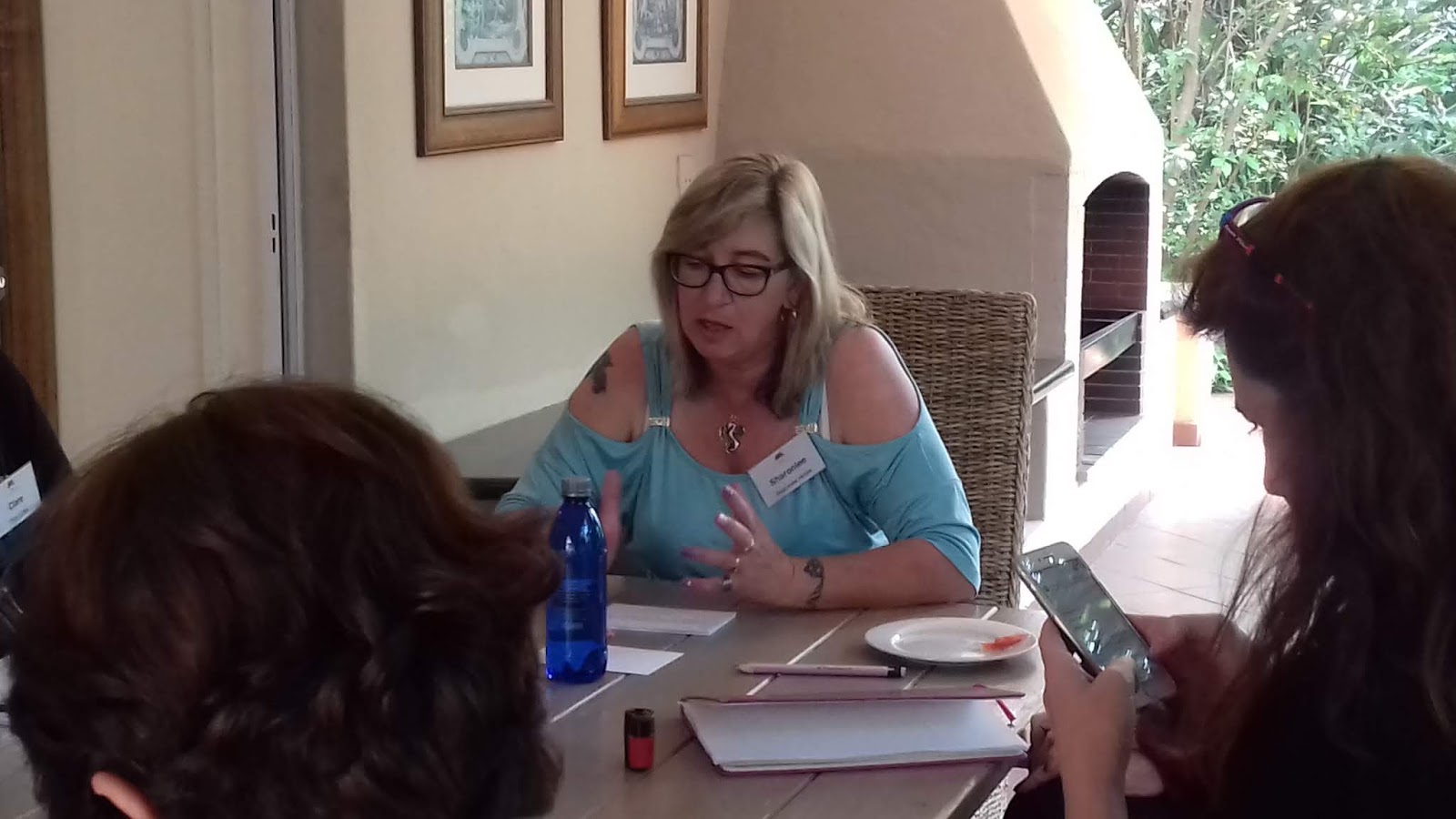
Melrose Place was the ideal venue, a comfortable and relaxing setting. The programme was well-balanced, with a stimulating variety of speakers and topics. There really was something for everyone, and sometimes something new: for example, I read very little paranormal fiction, romantic or otherwise, and will never attempt to write it (wait, never say never), but Sharonlee Holder’s session on Writing Paranormal was so much fun.

Sharonlee Holder's session on Writing Paranormal

There wasn’t a single session I didn’t enjoy and benefit from, out of those I attended. Thank you, everyone!

Something that struck me repeatedly was how supportive of each other all the ROSA writers were, published and yet-to-be alike. That’s something I appreciate about the South African writing community generally, but it was especially evident at the ROSA conference.

Thank you again, everyone, and congratulations to the Imbali and Strelitzia winners and finalists. Oh, and the goodie bags were amazingly generous!

Some of the goodie bag goodies

Wednesday, October 3, 2018

Love over the cultural lines

Today's post is a guest post from Cliffordene Norton, editor at Lapa Uitgewers.

* * *

Diversity has been a hot topic since I started working in the publishing industry and probably a long time before that. We live in a society where our racial and apartheid past has a huge influence on the way we currently view relationships between different races.

Image courtesy of Looks Like Me
In Afrikaans mainstream books these relationships are often not reflected or still representative of before 1994. From my point of view, diversity seems to be gaining momentum. I am a huge Marvel fan, and was so excited when Black Panther was released this year. I went to watch it three times in cinema and started following the #BlackPanther on Instagram. Since than I have seen countless posts on Instagram about why representation matters. These posts recently spiked again with Crazy Rich Asians.

Black Panther was a major influence and inspiration on the next generation of black kids. Looks Like Me, a UK talent and casting agency dedicated to raising the profile of underrepresented groups, commissioned photos where kids recreate the Black Panther characters.

It was evidence of the power of representation. I like to tell this story about my grade 8 class who got excited when we read Diekie Vannie Bo Kaap by Zulfah Otto Sallies. Everyone read, finished and enjoyed the book. We later performed scenes from the same book and it was the most interactive I’ve have ever experienced my fellow class mates with a book. It was also the first book where I could see my town, my people and some of my culture being authentically written about.

But for me the power of Diekie doesn’t just lie in its authenticity, it lies in the diverse characters in the book. There wasn’t just the maid cleaning the kitchen and cooking. Or the irresponsible taxi driver cutting you off or the blue overhaul worker making the main character feel unsafe. These characters were people I knew – people who were both right and wrong, educated and uneducated, successful and unsuccessful. They were just people, not stereotypes.

At the LAPA Uitgewers Writer’s Indaba in June this year Sophia Kapp cautioned Afrikaans writers about not just creating characters of colour that they know and are mentioned above. I want to add to that. Writers need to be careful about how their main characters interact or even think about other races. With the #BlackLivesMatter movement I think we’ve all become more vigilant about racial profiling. If your heroine, who forgot to lock her car doors, suddenly remembers when a group of blue overhaul workers crosses the road in front her, I immediately judge her. While safety must always come first, why does she associate danger with the race or class?

In the past (and I'm glad I haven’t read such characters in recent years) I’ve read romances where people of colour represent the negative aspects of humanity: laziness, self-entitlement, unattractiveness. It is a method sometimes used to show how the white hero or heroine possesses these traits – is the good in the world. I have come to ask myself: Does the character really possess good traits if it has to be compared to stereotypical version of another race? To me as a reader of colour it shows a lack of maturity in the character and the writer, because I never assumed every white man I have ever met is a racist or slave owner.

In her TED Talk, The danger of a single story, Nigerian writer, Chimamanda Ngozi Adichie, talks about how one story creates stereotypes. Representation is a necessity, but diversity in the portrayal of racial characters is a bigger necessity.

There is a spectrum of diverse white characters in books. That is why we don’t see Mr Darcy or Voldemort in every white man we encounter. And that is where a writer’s power lies, they show not to judge a book by the colour of its cover.

Source: Jasper, M. 2018. Kids Recreate the Black Panther Character Posters in This Awesome Photo Series

Thursday, August 9, 2018

Romanse en skeptiese feministe

Thank you to Cliffordene Norton, editor of Lapa Uitgewers, for today's guest post on feminism in Romance novels. This post is especially apt today, as we celebrate Women's Day here in South Africa.

* * *

’n Genre wat fokus op die liefdesverhouding tussen ’n man en ’n vrou laat gereeld wenkbroue lig, nie net by meeste mans nie, maar ook by vroue wat selferkende feministe is.

Volgens die patriargale sisteem is ’n vrou eers ’n volwaardige persoon nadat sy die titel van mevrou bygekry het. Indien sommige vroue dus romantiese fiksie wil vermy is dit te verstane.

Maar ons bevind ons nou in die 21ste eeu waar feminisme nie meer ’n vloekwoord is nie en feministe ook nie meer hulle bra’s verbrand en hulle beenhare laat groei nie. Kaalvoet en pregnant is by die deur uit saam met die siening dat ’n butch-voorkoms jou onafhanklikheid beklemtoon.

Janice Radway, ’n kenner op die gebied van romantiese fiksie, se navorsing bewys dat feminisme eintlik ’n subversiewe genre is omdat die skrywer (en die leser) mans skep soos vroue hulle wíl hê en nie soos hulle werklik is nie.

En nee, die lesers is nie almal treurige oujongnooiens wat alle hoop op liefde begrawe het en nou maar ’n genadige einde met nege katte inwag nie. Dié genre se heldinne is sterk vroue: besigheidsvroue, onderwysers, joernaliste, prokureurs - noem maar op. En so is die lesers, want die heldin is die leser se alterego.

Die romansegenre is onlosmaaklik verbind aan die evolusie van die vrouebeweging. Vroue is weer vroue sonder om hulle identiteit prys te gee en te probeer om soos mans te dink en te doen. Die moderne vrou voel sy is geregtig op haar eie tyd met ontvlugting soos romantiese fiksie wat haar emosioneel versorg. Want hoewel die kontemporêre vrou in teorie meer voordele het as haar susters van lank gelede, is sy steeds hoofsaaklik verantwoordelik vir die hele gesin se emosionele versorging terwyl sy op haar eie reserwes aangewese is vir haar eie versorging.

Geen moderne vrou kan identifiseer met ’n sorry-Suzie wat te dankbaar sal wees om haar man se skoensole te soen nie. Dus is die heldin sterk, onafhanklik, trots en hoewel sy nie, in die woorde van Romanzaskrywer Madelie Human, “haar bra hoef te verbrand om op haar regte te staan nie” – kry sy haar spreekbeurt.

Die held daarteen is haar gelyke. Hy vul haar aan en aanvaar haar ware self, sonder om ’n vloerlap te wees waar sy haar stiletto’s kan afvee. Hulle is lief vir mekaar en waarom kan die liefde en feminisme nie hand-aan-hand loop nie?

Die feministe vergeet gerieflikheidshalwe dat romantiese fiksie ’n genre is wat deur vroulike skrywers oorheers word. Of dat dit vroue toegelaat het om hul eie geld te verdien in ’n era voor vroue die arbeidsmark kon betree.

Vurige heldinne lewer beslis ’n bydra tot die opheffing van vroue. Of dit so direk is soos die heldinne van die Davelvroue-reeks of meer indirek deur rolmodelle te wees.

Die Amerikaanse skrywer, Suzanne Brockmann, sê oor haar heldinne: “Ek dink die boodskap wat ek deur my boeke stuur is dat vroue sterk kan wees. En dat vroue sterk moet wees. En dat die liefde nie gaan oor die verlies van jouself nie, maar eerder om saam met jou geliefde te werk. Dit gaan nie oor ‘Eendag sal my prins kom en my volledig maak nie’ eerder ‘Eendag gaan ek iemand ontmoet, en ons sal langs mekaar werk om saam ’n toekoms te bou."

En dis die kern van die romanse: Vroue word op ’n subtiele wyse bemagtig.

Image courtesy of pixabay.com

Thursday, July 26, 2018

Partridge Publishing, Author Solutions and other publishing scams

Image courtesy of pixabay.com
Have you heard of 'ambulance chasers'? Those are lawyers who chase after ambulances in order to persuade the victims of accidents to sue so they can make money. They're not particularly respected in the legal fraternity, and generally they're considered to be the lawyers so bad at what they do that they can't get business in more legit ways.

Well, we have ambulance chasers in the publishing industry too - in fact, they're worse than dodgy lawyers. Because these aren't just dodgy publishers, they're conmen pretending to be publishers. They often call themselves 'self-publishing imprints' (which is a huge misnomer, since an 'imprint' is a division of a publisher, while self publishing means going it alone without a publisher) but the rest of the industry knows them better as 'vanity presses'.

A vanity press is a 'publishing' company that appeals to the vanity of newbie writers. Aspirant writers send in their manuscripts and receive glowing praise back telling them their books are wonderful, and that the publisher most definitely wants to publish their books - for a price.

The aspirant writer, basking in the glow of the praise, and under pressure from the publisher, doesn't think to go to Google and double check the publisher's credibility (or if they do, they don't look beyond the first few hits on Google, which are usually the publisher's own website) and so they sign up and hand over their credit card details to publish their book.

At this stage, you're probably thinking "Where's the con in that? The author paid for a service, and got it." The answer is: yes and no.

Sure, the author paid and got a service. But it probably wasn't the service they were expecting. Because instead of their wonderful, "sure to be a bestseller" book rocketing up the charts, the only copies sold are the ones the author buys. Why?

Because the customers of these types of publishers are not readers. Their customers are the authors. Remember that hefty fee you paid up front - why would they need to sell books to readers when they already have your money in the bank? They are in the business of selling your own books to you. And if that isn't already bad enough, they won't stop there.

Once you've signed up with them, they will continue to contact you to sell you new products and 'top up packages'. Your first ebook cover goes up on Amazon, and while you're still going "squee! I have a real book!" they invite you to order print books. Still basking in the glow, you agree. Another payment goes off your account. The box of books arrives, and you're so excited to see your name on a real cover. Within hours you get the phone call inviting you to now buy their 'marketing' package. It's not accidental. They track the courier package, know when you signed for the parcel, and catch you while you're still riding the high of opening that parcel of books. And that's why they call it vanity publishing - they are master manipulators at playing to an author's vanity.

Before you know it, you've shelled out thousands and thousands of Rands - and sadly, only then do most of their authors finally start to ask "but what am I getting in return for my money?" Chances are: very little. Aside from being able to say to friends and family "look, my book is available on Amazon" and apart from that box of books you've paid for which are taking up space in your garage, you are unlikely to sell a single copy.

Most books published by these vanity publishers are poorly edited, if at all. Most are not yet ready for publication, as any legit publisher would tell you. Most have atrocious covers which are not professionally designed to attract the right kind of readers. And that 'marketing' you paid for was probably limited to a press release to newspapers and reviewers who didn't even read it.

Instead, for a fraction of the price, you could have bought a pre-made cover, hired an editor, and sent out your own targeted review requests (for free), and you'd have a far more saleable product.

But you know what the real tragedy is? The real tragedy is that aspiring authors fall for these scams every single day. It amazes me how easily people spends thousands of Rands without even doing the simplest of Google searches. An internet search would reveal articles such as this one on MyeBook.co.za, this article by respected indie author David Gaughran, this link to Independent Publishing Magazine, and the entire Writers Beware blog.

So how, aside from doing a Google search, can you sniff out which publishers are legit and which are scams? Here are a few questions to ask yourself before handing over your credit card details:
  • Did you find this publisher by clicking on an advert? Real publishers don't take out Google ads - they don't need to.
  • Were you referred to this publisher by a well known publishing house that wasn't itself prepared to publish your book? The bad news is that the biggest vanity publisher on the block, Author Solutions, is in partnership with big, well known publishers. Books that aren't yet publishable get passed on to vanity publishers so they can still make money off your book without actually having to put the reputable publisher's name on your book.
  • Is this publisher a specialist in your genre? Even if they are a legit publishing company, if they don't represent your types of books, they're probably not a good fit for your book.
  • Did they ask you to do edits before offering you a contract? Legit publishers will always ask for revisions before agreeing to buy an unagented debut book. Apart from the fact that all debut books require edits, this is also a test to see if the author is prepared to work with the editor or if they are divas. However, vanity publishers don't care about the quality of your book. They'll tell you it's great and they really want to publish it - without even reading your manuscript.
  • What are their previous and current authors saying about them? Most authors don't mind being contacted for referrals. Finding out if their existing authors are happy with the publisher is as important as asking your Audi-driving friend for their opinion on Audi servicing before you walk into a dealership and sign to buy the latest A4.
  • How do the books they've published rank on Amazon? (Note: books that rank over 1 million are not selling well)
  • They make elaborate claims that your book will be a bestseller, will be made into a movie, or promise a guaranteed number of reviews. No legitimate publisher will make these sorts of promises, since these things cannot be guaranteed.
  • Are they asking you to pay to be published? Legitimate publishing companies cover the costs of editors, cover designers etc and do not ask you for a cent. If you are truly self-publishing, the you would be able to select your choice of cover designer, editor, publicist, formatter and you would negotiate individually with each of these service providers.
  • Are they charging rates that are exorbitant in comparison with what you would pay individual service providers? If you're not sure what reasonable rates are for editing, covers, book formatting etc, then check out this page on our ROSA website.
  • Are they keeping part of your royalties for themselves, even after charging you an up front payment? True self publishing service providers (such as editors and cover designers) get a flat, negotiated rate - they do not get a share of the royalties.
  • Finally, are they linked in any way to Author Solutions? This is the parent company which owns a vast array of vanity publishers, including local Partridge Africa. But there are others too.
In summary, a traditional publisher will cover all costs of publishing your book, in return for a share of the book sales. A self-publisher (you!) pays service providers to assist with specific aspects of publishing, but keeps all profit from book sales and all rights to those books. Anyone who asks you for a share of the profits or rights to your work in addition to charging you a fee is most likely a vanity publisher.

Yes, we understand how desperately you want to be published, how demoralising it is to receive form rejection after form rejection, and how tempting it is to be seduced by the claims of these vanity publishers. But I beg that before you let yourself be seduced, please read all the articles linked in this post.

Even if you don't want to wade through all those articles, read this very short one. It not only gives an overview of the issues faced by customers of vanity publishers, but gives some very handy tips on how to ensure your book is good enough to attract the right kind of attention from the right kind of publishers.

Have you been approached by a vanity publisher, or fallen for one of their scams? Do you have a story to tell? Share your experiences in the comments below to help other writers avoid making the same mistakes.


Thursday, July 12, 2018

New release: Last of the Summer Vines

I continuously remind ROSA members that they can use this blog to promote their new releases, but my own release day came and went and I didn't even think to post about it here! So, to set a good example for all our members, today I'm talking about my book Last of the Summer Vines, which released two weeks ago.

This wasn't a book I planned to write. I'd written a book set behind the scenes on a television series (which won't surprise readers of my previous books) and had just started work on its sequel. But I was struggling to find a home for the completed book, and with each passing month my motivation for writing died a little more. It's hard to write a sequel, no matter how passionate you are about it, when every agent or publisher you query rejects the first book in the series.

Thank heavens for my lovely editor at HarperImpulse, Charlotte Ledger. Though my new books were very different from the kinds of books HarperImpulse were currently publishing, she agreed to read it and give me feedback - and then she gave me the best gift ever: she suggested I write something completely different.

Charlotte suggested I write the kind of book that's currently selling really well in the UK, books I'd taken to calling 'cosy teashop' books. These are gentle books, in which the heroine leaves the big city to rediscover herself in a simpler, country setting - and they usually involve lots of tempting food. Charlotte also suggested Tuscany as a setting. And so I started researching both the genre and the setting. And through researching and then writing this book, I rediscovered my passion for writing again.

Last of the Summer Vines is now on sale, and the reviews that are coming in are very encouraging. But they are just the cherry on the top, because even if no one else likes this book, it's achieved a miracle in my life. It inspired me again, and showed me new possibilities for my career - all the things that the book's heroine, Sarah Wells, discovers when she spends a summer in Tuscany.

I don't expect readers to experience any life-altering revelations while reading Last of the Summer Vines. But if you read this book and get swept away for a few hours, then my joy will be complete.


Love grows where you least expect to find it…

When ambitious workaholic Sarah Wells discovers she has inherited her estranged father’s vineyard near Montalcino in Tuscany, the last thing she wants is to take time away from her busy schedule to sort out a crumbling mess of a palazzo. But, of course, life never runs smoothly and when she makes a rare error, her bosses decide a holiday is just what she needs.

When Sarah arrives in Italy, she learns that she is not her father’s sole heir. In fact, she only has a partial stake in Castel Sant’ Angelo because of a loophole in Italian law. Her father has left the vineyard instead to his business partner, the gorgeous and infuriating Tommaso Di Biasi – and Tomasso doesn’t want to sell.

At first, Sarah wants the deal done as quickly as possible so she can get back to her life in London, but it seems Italy has other plans for her. Under the warmth of the Tuscan sun, with a glass or two of the local vino rosso, and brooding Tommaso challenging her all the way, Sarah starts to realise that that there might just be something to la dolce vita…

Last of the Summer Vines is available from Amazon, Kobo, iBooks, Google Play and Barnes & Noble.